How to Use “Multi-Agent Systems” to Automate Customer Service Ticketing in a Small IT Department
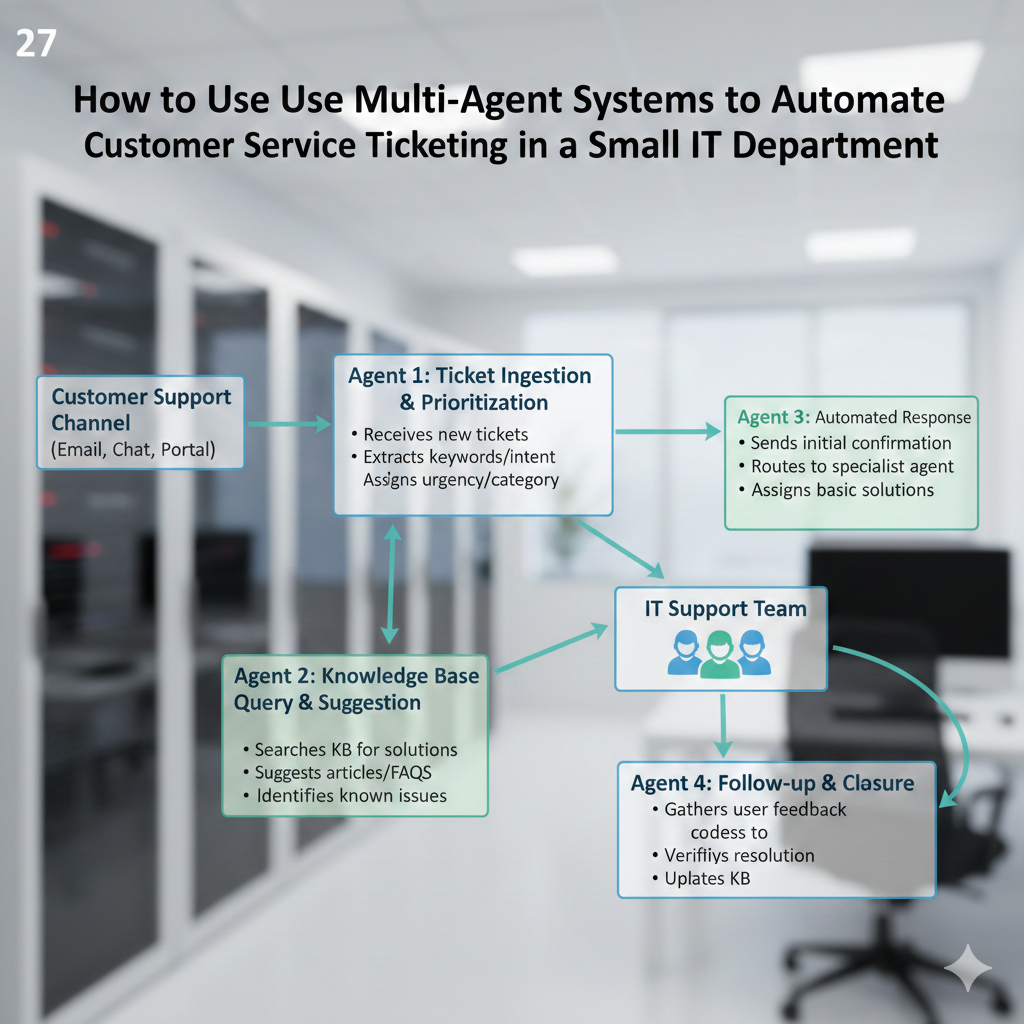
How to Use “Multi-Agent Systems” to Automate Customer Service Ticketing in a Small IT Department
It might be difficult for smaller information technology teams to effectively handle the increasing number of customer support inquiries. Automating ticketing procedures may be accomplished via the use of multi-agent systems (MAS), which are characterized by the collaboration of several autonomous artificial intelligence agents in order to accomplish tasks. Small information technology teams are able to react more quickly, minimize the likelihood of human error, and maintain high service standards without increasing their workforce if they coordinate agents to classify, prioritize, and route requests. Through the implementation of MAS, ticket management is transformed from a labor-intensive and reactive procedure into a proactive and automated workflow that provides assistance to both your team and your end users.
Acquiring Knowledge about Multi-Agent Systems in Information Technology Support
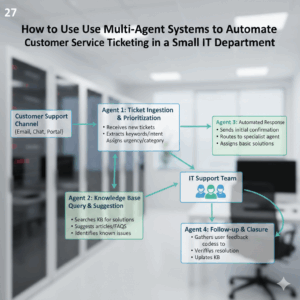
Independent agents that communicate with one another, work together, and make choices based on predetermined objectives and guidelines are the foundation of multi-agent systems. Agents are able to undertake a variety of activities within the framework of IT ticketing, including the identification of different kinds of issues, the suggestion of remedies, the escalation of urgent tickets, and communication with end users. Every single agent functions independently, yet they collaborate with one another to ensure that the workflow remains consistent. For the purpose of developing a system that optimizes efficiency without losing accuracy or accountability in service delivery, it is essential to have a solid understanding of how these agents communicate with one another and exchange their information.
Mapping Workflows for Ticketing in Order to Automate Them
It is recommended that IT teams do an analysis of the current ticketing operations before implementing MAS. The identification of typical request types, response times, escalation procedures, and bottlenecks are all things that fall under this category. The ability to handle password resets, software installs, and network issues are all examples of requests that may be categorized, which enables agents to specialize in their job. The definition of these processes guarantees that the MAS will be able to prioritize jobs in an efficient manner and route them in the proper manner. For the purpose of preventing mistakes and ensuring that automation serves to complement human personnel rather than to create confusion, a comprehensive grasp of workflow dynamics is essential.
Developing Roles and Responsibilities for Agents Designing
Each agent in a multi-agent system is assigned a certain role that is in accordance with the needs of the workflow. Some agents are able to concentrate on first ticket triage, which involves assessing the text of customer requests to classify them according to their level of urgency. They are responsible for handling regular resolutions, which may include delivering pre-approved replies or carrying out planned procedures. In the event that it is necessary, escalation agents will direct difficult situations to human technicians. In order to maintain seamless coordination and to minimize duplication or conflict amongst agents, clear definitions of roles, duties, and decision limits are essential. This helps to improve the overall efficiency of the system itself.
Bringing MAS into Integration with Already Existing Ticketing Platforms
The integration of multi-agent systems with pre-existing ticketing tools, email systems, chatbots, and software for managing IT services is possible. It is possible for agents to obtain ticket data, amend the status of tickets, and engage with users via the use of APIs and workflow automation tools. The maintenance of a unified service experience for consumers is ensured by seamless integration, which prevents automation from disrupting activities that are already in progress. In order to maximize the efficacy of the MAS in real-world information technology operations, it is necessary to properly configure connections, authentication, and data processing. This will assure dependability and security.
Performance and Accuracy Monitoring and Evaluation
It is necessary to perform continuous monitoring of even the most advanced MAS in order to guarantee accuracy and effectiveness. Metrics such as the amount of time it takes to resolve tickets, the accuracy of agent responses, the frequency of escalations, and customer happiness should be monitored by IT teams. Regular review enables adjustments to be made to agent rules, retraining on updated ticket trends, and the fine-tuning of process priorities. Continuous performance monitoring helps to avoid mistakes from multiplying and ensuring that automated ticket processing contributes to the department’s goals rather than hindering them.
Employing Feedback Loops in the Training of Agents
Over the course of time, agents become more effective by means of feedback loops that combine both human evaluation and machine learning. It is possible for technicians to amend the output and input this information back into the system in the event that agents have made wrong categorizations or have provided solutions that are incomplete. Over the course of time, agents acquire the ability to recognize patterns in requests and enhance their decision-making skills. By incorporating feedback loops, the Management Accounting System (MAS) is guaranteed to become more accurate, efficient, and aligned with human knowledge, which eventually results in an improvement in the quality of service that is offered by smaller IT departments.
The Protection of Personal Information and Data
The presence of automation brings forth new concerns about the privacy and security of data. A responsible approach to handling sensitive ticket material, compliance with company regulations, and prevention of illegal access are all requirements for MAS agents. The maintenance of secrecy may be accomplished by the implementation of role-based permissions, secure communication routes, and data encryption. These security measures are crucial for departments that manage personal or corporate information in order to ensure compliance with rules and safeguard both the company and its customers while also protecting the organization itself.
Using MAS to Scale Up Small Technology Operations
Small information technology departments are able to grow their operations without having to hire a proportionate increase in people after multi-agent systems have been introduced. Agents have the ability to handle high ticket numbers, requests that are repeated, and initial triage, which frees up human technicians to concentrate on more difficult issues. Over the course of time, MAS has the potential to be developed to include knowledge-base management, automated reporting, and predictive problem identification. It is possible for small IT teams to retain service quality, decrease response times, and boost overall operational efficiency by using intelligent automation. This results in the creation of a support environment that is prepared for the future.